Zero Fee Guarantee. Maximum Results.
Your case gets the personalized attention it deserves from day one.
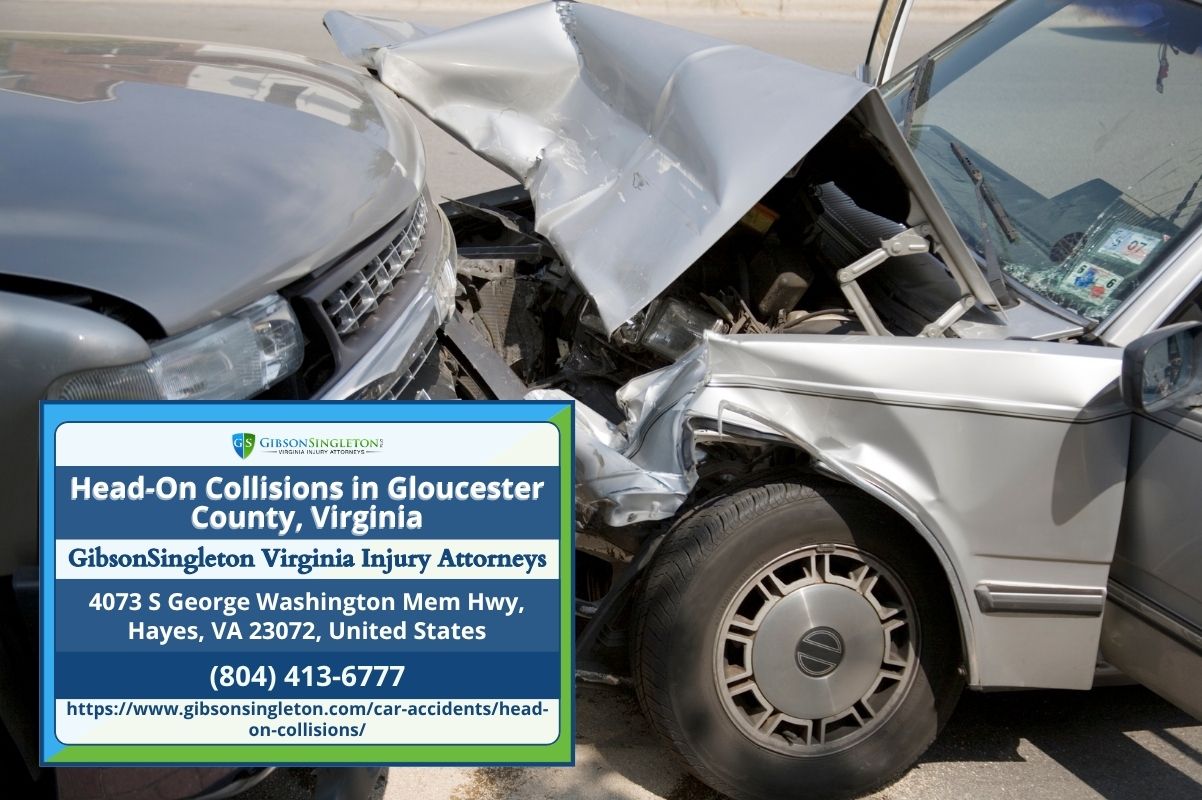
A head-on collision can change everything in an instant. One moment you are driving along Route 17, and the next you are facing serious injuries, mounting medical bills, and an uncertain future. These crashes are among the deadliest on Virginia roads, and Gloucester County sees more than its share due to the high-speed traffic corridors that connect the Middle Peninsula to Hampton Roads.
Ken Gibson and John Singleton bring valuable experience to head-on collision cases in Gloucester County. Ken Gibson previously served as a federal prosecutor with the U.S. Department of Justice and earned a commendation from the FBI Director for his trial work. John Singleton is a former insurance defense attorney who understands how insurers evaluate and attempt to minimize claims. Together, they combine trial strength and insider knowledge of the insurance industry to represent head-on collision victims throughout Gloucester County and the surrounding region.
In this article, we explain what causes head-on collisions on Gloucester County roads, common injuries victims suffer, what to do after a crash, how Virginia’s contributory negligence law affects your claim, what compensation you may recover, and how the statute of limitations applies. Call GibsonSingleton Virginia Injury Attorneys at (804) 413-6777 to speak with experienced car accident lawyers about your case.
Recent Case Results
Trucking Crash
$1,000,000
Compensation for the family of a driver who was killed in a tractor-trailer truck crash.
Auto Accident
$725,000
Sexual Abuse
$1,000,000
Motorcycle Accident
$300,000
Compensation for a motorcyclist who suffered a fractured pelvis and femur when a driver failed to yield.
When Insurance Companies Won't Listen, These Lawyers Make Them

Linda Heron

James Roark
I was rear-ended by someone who didn’t see me slowing for traffic in front of her because she had a dog in her car and she was handling her dog instead of watching the road. She was cited and pre-paid her ticket (was undeniably at-fault for the accident). I was slammed so hard my car was slammed into the car in….

Jacki P

Your Recovery Starts with the Right Team
Military precision meets compassionate advocacy, no fees unless we deliver results for you.
Head-on collisions occur when two vehicles traveling in opposite directions strike each other front-to-front. The combined speed and force of both vehicles make these crashes far more destructive than other types of accidents. In Gloucester County, several local road conditions contribute to the frequency and severity of these crashes.
Route 17, the George Washington Memorial Highway, is a four-lane divided highway that serves as the primary corridor through the county. Many intersections along Route 17 lack dedicated left-turn lanes, forcing drivers to cross opposing traffic at high speeds. The Virginia Department of Transportation (VDOT) completed a $5.1 million safety improvement project at the Route 17 and Route 610 (Woods Cross Road/Davenport Road) intersection to modify turning movements and improve safety.
The Coleman Bridge, which connects Gloucester Point to York County across the York River, also creates unique traffic patterns that increase collision risk. Summer beach traffic compounds the danger, bringing unfamiliar drivers onto local roads and creating congestion that leads to impatient passing maneuvers.
Common causes of head-on crashes in the area include:
Key Takeaway: Head-on collisions in Gloucester County frequently occur on Route 17 and other high-speed corridors where dangerous intersections, seasonal traffic surges, and limited turn lanes create conditions for catastrophic crashes.
GibsonSingleton Virginia Injury Attorneys can evaluate the circumstances of your head-on collision and identify what caused the crash. Call (804) 413-6777 for a consultation.
Head-on collisions produce some of the most severe injuries of any type of motor vehicle accident. When two vehicles collide front-to-front, the combined force can be double what either vehicle experiences individually. A crash involving two cars, each traveling at 45 mph, generates an impact comparable to hitting a concrete wall at 45 mph for each occupant.
The human body is not designed to withstand these forces. Even with modern safety features like airbags, seatbelts, and crumple zones, the abrupt deceleration can cause catastrophic harm to the brain, spine, and internal organs.
Traumatic brain injury (TBI) is a condition caused by a violent blow or jolt to the head that disrupts normal brain function. In a head-on crash, the brain can slam against the inside of the skull even when the head does not strike a surface. Symptoms range from headaches and confusion to long-term memory loss, personality changes, and cognitive impairment. Riverside Walter Reed Hospital in Gloucester and Riverside Regional Medical Center in Newport News both treat head-on collision victims with brain injuries.
The force of a head-on collision can fracture or dislocate vertebrae, damaging the spinal cord and potentially causing partial or complete paralysis. Victims may face permanent wheelchair use, loss of sensation, and dependence on caregivers for daily activities.
The steering wheel, dashboard, and seatbelt can cause blunt force trauma to the chest. Internal bleeding, collapsed lungs, and damage to the heart, liver, spleen, or kidneys may not be immediately apparent but can become life-threatening without prompt treatment.
Key Takeaway: Head-on collisions frequently cause traumatic brain injuries, spinal cord damage, and internal organ injuries that require emergency treatment at regional trauma centers like Riverside Regional Medical Center in Newport News.
If you suffered serious injuries in a head-on crash on Route 17 or elsewhere in Gloucester County, contact GibsonSingleton Virginia Injury Attorneys to discuss your case. Call (804) 413-6777.
They Made a Stressful Situation Feel Manageable

Lisa Ward
I had the pleasure of working with Ken Gibson and his staff after a car accident, and I couldn’t be more pleased. From the very first consultation, they made me feel confident and well-represented. The entire process was smooth, and they kept me updated every step of the way…

Shelley Kinser

Quevon Kinlow
Your Recovery Starts with the Right Team
Military precision meets compassionate advocacy, no fees unless we deliver results for you.
Seek medical attention immediately, even if you believe your injuries are minor. Many head-on collision injuries, including internal bleeding and traumatic brain injuries, may not produce obvious symptoms for hours or days after the crash. Prompt medical evaluation creates documentation that connects your injuries directly to the collision.
After addressing your immediate safety, take these steps to protect your health and your legal rights:
Key Takeaway: After a head-on collision, seek immediate medical care, report the accident to law enforcement, document everything, and contact an attorney before speaking with the other driver’s insurance company.
John Singleton of GibsonSingleton Virginia Injury Attorneys previously worked for an insurance defense firm and understands how insurers build cases to deny claims. Call (804) 413-6777 for guidance after a head-on crash.
No Upfront Costs to Zero Fee Guarantee.
Your case gets the personal attention and legal experience it deserves from day one.
Virginia follows a pure contributory negligence doctrine, which is one of the strictest fault standards in the country. Under this rule, if you are found even one percent at fault for the accident, you may be completely barred from recovering any compensation.
Only four states and the District of Columbia still follow this rule. Most other states use comparative negligence systems that reduce your compensation in proportion to your share of fault rather than eliminating it.
Insurance adjusters handling Gloucester County head-on collision claims will look for any evidence that you contributed to the crash. Common arguments include:
These arguments do not need to show you were primarily at fault. Any negligence that a jury finds contributed to the collision can bar your entire claim.
Virginia does recognize the “last clear chance” doctrine. If the other driver had the final opportunity to avoid the crash but failed to do so, you may still recover damages even if you were partially negligent earlier in the chain of events. Proving the last clear chance requires detailed evidence of the moments leading up to impact.
Key Takeaway: Virginia’s contributory negligence rule can bar you from recovering any compensation if you are found even slightly at fault. Insurance companies aggressively use this doctrine to deny head-on collision claims, making strong evidence collection and legal representation critical.
Ken Gibson has tried cases before Virginia courts and understands how to counter contributory negligence defenses. Contact GibsonSingleton Virginia Injury Attorneys at (804) 413-6777.
Support You Can Count On After an Accident

Barbara Deaver
On April 14, 2021, I was in a vehicle accident, my leg was broken. I was taken to the hospital for surgery, now I have four screws and wire in my leg. I didn’t know anything about lawyers. I was at dinner one night; my leg was in a brace the owner asked me what happened. I told him and he recommended GibsonSingleton….

Bo Dixon
Ken Gibson and John Singleton are first class attorneys. They are professional, dependable, family oriented, and down to earth people. They will work with you to make sure you get quality representation at a fair price. I have had representation from each of them, both with winning outcomes…

Taffi Simone
Your Recovery Starts with the Right Team
Military precision meets compassionate advocacy, no fees unless we deliver results for you.
The driver who crossed the center line or traveled into oncoming traffic is typically at fault for a head-on collision. However, liability is not always straightforward, and multiple parties may share responsibility depending on the circumstances.
Virginia follows an at-fault insurance system, meaning the negligent driver’s policy is responsible for compensating the injured victim. Establishing fault requires evidence from the crash scene, witness testimony, and sometimes accident reconstruction analysis.
| Potentially Liable Party | How They May Be Responsible |
|---|---|
| The other driver | Distracted, impaired, drowsy, or reckless driving that caused them to cross the center line |
| An employer | If the at-fault driver was working at the time (delivery driver, commercial vehicle operator) |
| A vehicle manufacturer | If a defective part, such as faulty steering or a tire blowout, caused loss of control |
| A government entity | If dangerous road conditions, missing signage, or poor road design contributed to the crash |
| A maintenance provider | If negligent vehicle repairs caused a mechanical failure leading to the collision |
Building a strong case for a head-on collision claim typically involves:
Key Takeaway: While the driver who crossed the center line is usually at fault, Virginia law may allow claims against employers, vehicle manufacturers, or government entities when their negligence contributed to the head-on collision.
GibsonSingleton Virginia Injury Attorneys investigates every aspect of a head-on collision to identify all responsible parties. Call (804) 413-6777.

Ken Gibson is a former federal prosecutor at the U.S. Department of Justice, Civil Rights Division, where he served as Deputy Chief of Special Litigation and Criminal Sections from 2004 to 2009. He previously served as an Assistant Commonwealth’s Attorney in Norfolk from 1998 to 2004.
Ken received a Certificate of Commendation from FBI Director Robert S. Mueller, III, and Special Achievement Awards for Outstanding Performance from the Department of Justice. He earned his Juris Doctor from the University of South Carolina School of Law, where he was a member of the South Carolina Law Review and Order of the Wig and Robe, and his Bachelor of Arts in Foreign Affairs from the University of Virginia. Ken served in the United States Marine Corps Reserves from 1991 to 1995.

John Singleton is a graduate of Colby College in Waterville, Maine, and Mercer University Law School in Macon, Georgia. He gained his litigation background at a large insurance defense firm in West Virginia, giving him direct insight into how insurance companies evaluate, negotiate, and defend against injury claims.
John serves as a Special Justice for the Ninth Judicial Circuit, hearing adult mental health commitment matters. He served in the United States Marine Corps in China and Beirut, Lebanon. John is an active member of the Middle Peninsula Bar Association, The Fairfield Foundation, Gloucester-Mathews Care Clinic, and Rural Housing.
Prepared for Every Step, Treated Like Family
I recommend to anyone who needs an injury attorney to use Gibson and Singleton. John did an excellent job helping me get a fair settlement. I could not have navigated through everything myself. John and everyone in the office are always friendly and professional…

C Holt
This is a great Law Firm to work with. They helped me through every aspect and prepared me for every step of the case. I feel as if I have gained a group of new friends. Attorneys Gibson and Singleton both are true professionals. Their assistants are great and very professional also. Thank All of You for Everything…

Patrick Howard
Choosing GibsonSingleton was one of the best decisions I made. In 2023, I was involved in a frightening car accident that left me injured and unsure of my next steps. After seeking help from a personal injury expert, I found GibsonSingleton, and I’m so grateful I did…

Sherrie
Your Recovery Starts with the Right Team
Military precision meets compassionate advocacy, no fees unless we deliver results for you.
Virginia law allows head-on collision victims to recover both economic and non-economic damages from the at-fault driver. Economic damages cover measurable financial losses, while non-economic damages compensate for the physical and emotional toll of the injury. Virginia does not cap compensatory damages in personal injury cases, except in medical malpractice claims.
In cases involving extreme recklessness, such as drunk driving, Virginia courts may also award punitive damages. Under Virginia Code § 8.01-38.1, punitive damages are capped at $350,000 and are intended to punish the wrongdoer and deter similar conduct.
Key Takeaway: Virginia head-on collision victims can recover medical expenses, lost wages, pain and suffering, and other damages without a cap on compensatory awards. Punitive damages may apply in cases involving drunk or reckless driving.
Ken Gibson and John Singleton of GibsonSingleton Virginia Injury Attorneys can calculate the full value of your head-on collision claim, including future medical needs and lost earning capacity. Call (804) 413-6777.
They Made a Stressful Situation Feel Manageable
Lisa Ward
Quevon Kinlow
I had the pleasure of working with Ken Gibson and his staff after a car accident, and I couldn’t be more pleased. From the very first consultation, they made me feel confident and well-represented. The entire process was smooth, and they kept me updated every step of the way…
Shelley Kinser
Your Recovery Starts with the Right Team
Military precision meets compassionate advocacy, no fees unless we deliver results for you.
Under Virginia Code § 8.01-243, you have two years from the date of the accident to file a personal injury lawsuit. If a head-on collision results in a fatality, the deceased person’s representative has two years from the date of death to file a wrongful death claim under Virginia Code § 8.01-244.
Missing this deadline by even one day typically results in the court dismissing your case permanently, regardless of how strong your evidence is or how severe your injuries are.
Virginia courts strictly enforce the two-year deadline. There are limited exceptions:
Claims involving unsafe road conditions can have strict notice rules. Locality claims (county/city/town) generally require written notice within six months. Claims against the Commonwealth/VDOT generally require written notice within one year.
Key Takeaway: Virginia gives head-on collision victims two years from the crash date to file a lawsuit. Claims against government entities may require action within six months. Do not delay in contacting an attorney.
Head-on collisions have a higher risk of fatal or life-changing injury than many other crash types because the impact forces are concentrated in a direct frontal hit.
The physics of a head-on crash explain why the injuries are so severe. When two vehicles approach each other, the closing speed is the sum of both vehicles’ individual speeds. Two cars each traveling at 50 mph create a combined closing speed of 100 mph. The resulting force can collapse the engine compartment, push the dashboard into the passenger cabin, and trap occupants inside the wreckage.
The front of the vehicle absorbs the initial impact, and crumple zones can only dissipate so much energy. Front-seat occupants face direct exposure to:
Rear passengers also suffer serious injuries from the forward momentum that throws them into the seats or structures ahead of them.
Key Takeaway: Head-on collisions are approximately 12 times more likely to cause a fatality than other types of Virginia traffic crashes, according to Virginia DMV data. The combined speed and direct frontal impact make these accidents uniquely destructive.
If you lost a loved one in a head-on collision in Gloucester County, GibsonSingleton Virginia Injury Attorneys can help your family pursue a wrongful death claim. Call (804) 413-6777.
Schedule a Free Consultation
A head-on collision can leave you dealing with painful injuries, overwhelming medical bills, and uncertainty about your future. You should not have to handle the legal process alone while trying to recover.
Ken Gibson and John Singleton of GibsonSingleton Virginia Injury Attorneys have represented injured clients throughout the Middle Peninsula and Hampton Roads for years. The firm handles head-on collision claims in the Gloucester County Circuit Court and works with accident reconstruction professionals and medical consultants to build strong cases. Contact our Gloucester County car accident lawyers to discuss your case.
Call GibsonSingleton Virginia Injury Attorneys at (804) 413-6777 for a consultation. The firm’s office is located at 4073 George Washington Memorial Highway in Hayes, serving clients throughout Gloucester, Mathews County, Middlesex County, York County, James City County, Newport News, Hampton, and Williamsburg.
The value of a head-on collision case depends on the severity of your injuries, total medical expenses, lost income, and the impact on your daily life. Virginia does not cap compensatory damages in personal injury cases. Cases involving traumatic brain injuries, spinal cord damage, or wrongful death typically have higher values due to the extensive medical care and long-term consequences involved.
Virginia motor vehicle owner’s policies must provide at least $50,000 per person / $100,000 per accident for bodily injury and $25,000 for property damage for policies effective on or after January 1, 2025 (older policies had lower minimums). See Virginia Code § 46.2-472.
If a dangerous road condition, such as a missing guardrail, obscured signage, or a poorly designed intersection on Route 17, contributed to the crash, you may have a claim against VDOT or Gloucester County. Claims against government entities require a notice of claim within six months and involve specific procedural requirements.
The timeline depends on the complexity of the case, severity of injuries, and whether the case settles or goes to trial. Some cases resolve in several months through negotiation, while others involving disputed liability or catastrophic injuries may take a year or longer. Virginia’s two-year statute of limitations sets the outer boundary for filing a lawsuit.
Most personal injury claims settle through negotiation before trial. However, if the insurance company refuses to offer fair compensation, GibsonSingleton Virginia Injury Attorneys is prepared to take your case to the Gloucester County Circuit Court. Ken Gibson’s background as a federal prosecutor and John Singleton’s trial experience prepare them for courtroom advocacy.